
How to Prevent Rust and Corrosion on Boats and Boat Trailers
Boat trailer brake rotors deserve special attention because their exposed metal surfaces can develop visible oxidation surprisingly quickly after launching and retrieval. If you've noticed orange rust appearing on your rotors, read our guide to why boat trailer brake rotors rust after launching to learn what causes it, how to help prevent it, and when the corrosion may require closer inspection.
Every trip to the ramp can expose trailer brakes, springs, axles, fasteners, couplers, winches and other metal components to water, salt, road grime and humidity. Then everything gets parked and left to dry.
Do that repeatedly and corrosion has plenty of opportunities to get started.
Freshwater boaters aren't completely off the hook either. Any exposed ferrous metal can oxidize when moisture and oxygen are present, and scratches or damaged protective coatings can leave previously protected surfaces vulnerable.
The good news is that corrosion doesn't have to be something you think about only after orange rust starts appearing.
A simple routine built around rinsing, inspecting, drying and protecting exposed metal can help keep a boat and trailer looking better while giving you an opportunity to catch corrosion before it becomes a much bigger problem.
Here's where to start.
Why Boat Trailers Are So Vulnerable to Corrosion
Think about what happens during a typical day on the water.
You tow the boat to the ramp.
You back the trailer into the water.
Depending on the trailer and launch, the wheels, brakes, hubs, axles, springs and portions of the frame may all be exposed to water.
Then you pull the trailer out.
It sits in the parking lot while you enjoy the boat.
Later, you submerge it again to retrieve the boat.
Then you tow everything home.
That's a repeated cycle of wetting, drying, contamination and storage.
In saltwater, the environment is considerably more aggressive. Salt-contaminated water can accelerate corrosion, which is why freshwater rinsing after saltwater exposure is such a common recommendation in marine maintenance.
BoatUS recommends rinsing a boat trailer after a day on the water and specifically warns that saltwater corrodes metal components faster than freshwater. It also notes that even aluminum and galvanized trailers can contain bolts, nuts, hangers and other components made from different materials that still require attention.
The trailer may look rugged.
That doesn't make it maintenance-free.
Saltwater vs. Freshwater: Does It Really Matter?
Absolutely.
Both freshwater and saltwater can contribute to corrosion, but saltwater creates a much more aggressive environment for many metals.
That's why a trailer used at the Jersey Shore faces a different maintenance challenge than one that spends its life launching into an inland freshwater lake.
But "freshwater" doesn't mean "no corrosion."
Water can remain trapped around hardware and braking components. Dirt and sediment can accumulate. Protective coatings can become scratched or damaged. Bare steel can oxidize.
The best habit is therefore simple:
Treat every launch as water exposure worth addressing, and be especially diligent after saltwater use.
The Most Important Step After a Saltwater Launch
Before reaching for a corrosion-protection product, do something simpler.
Rinse the trailer thoroughly with clean freshwater.
This matters because you don't want to seal contamination against a surface. You want to remove salt, sediment and grime first.
Pay attention to more than the large, easy-to-see sections of the frame.
Rinse areas such as:
- Brake assemblies
- Rotors and hubs
- Axles
- Leaf springs and suspension components
- U-bolts
- Fasteners
- Safety chains
- Coupler hardware
- Winch hardware
- Jack components
- Exposed brackets and mounts
- Other metal surfaces that were submerged or sprayed
BoatUS recommends freshwater rinsing of trailer brakes after saltwater use and notes that dirt and sediment from freshwater should also be removed. Its trailer guidance also suggests reaching difficult areas underneath the trailer rather than concentrating only on what is visible from above.
The ten minutes you spend rinsing after a launch can be far more valuable than trying to deal with established corrosion later.
Don't Forget the Trailer Brakes
Trailer brakes deserve special attention.
They're mounted exactly where you don't want delicate components to live: close to the road and, on many boat trailers, repeatedly exposed to water.
Saltwater makes that combination even harsher.
BoatUS recommends keeping trailer brakes clean and rinsing them with freshwater after saltwater use. Its guidance also emphasizes routine visual inspection for worn parts, rust and corrosion.
If your trailer has disc brakes, the exposed components are relatively accessible for rinsing and inspection.
Drum brake systems can be more difficult to rinse internally, and some trailers use dedicated flushing systems.
Follow your trailer and brake manufacturer's maintenance procedures.
Corrosion protection can be part of that routine, but it never replaces inspection or mechanical service.
If brake components show heavy rust, damaged lines, leaks, unusual wear or questionable operation, have the system serviced before towing.
What About the Trailer Frame?
Boat trailers are commonly built from galvanized steel or aluminum because both offer advantages in marine environments.
Neither means you can stop paying attention.
A galvanized steel trailer relies on its zinc coating to help protect the underlying steel. Scratches, damage and years of exposure can compromise that protection.
An aluminum trailer resists the familiar red rust associated with iron, but the trailer still contains hardware and components made from other materials. Fasteners, suspension parts, brakes, couplers, chains and other pieces can remain vulnerable.
That's why looking only at the main frame can create a false sense of security.
The small components matter too.
The Places Rust Likes to Hide
Corrosion doesn't always begin where it's easiest to see.
Spend a little extra time inspecting:
Leaf Springs and Suspension
Springs live low to the ground and are regularly exposed to water and road debris.
Look around spring leaves, mounting points, U-bolts and brackets.
Axles
Inspect the axle itself and areas around mounting hardware.
Safety Chains
Safety chains are easy to overlook until they're needed.
Check for significant rust, damage and questionable attachment points.
Winch and Bow Hardware
The winch, mounting hardware, hook and related components spend their lives around water.
Inspect them regularly and lubricate components according to the manufacturer's instructions.
Coupler and Jack
These components encounter road spray, rain and water around the launch ramp even when they aren't fully submerged.
Brakes and Brake Hardware
Look beyond the rotor face. Inspect calipers, lines, mounting hardware and surrounding components.
Fasteners
Nuts, bolts, washers and brackets can be made from different metals than the trailer frame itself.
Don't assume they're protected simply because the frame looks good.
Why "Stainless" Doesn't Mean "Impossible to Corrode"
Stainless steel is highly useful in marine environments because of its corrosion resistance.
But the name sometimes creates the impression that it can never corrode.
That's not true.
Different stainless alloys have different levels of corrosion resistance, and marine environments can be demanding. BoatUS notes, for example, that 316 stainless generally resists corrosion better than 304 stainless in marine use.
Stainless components also need inspection.
If you see staining, pitting, cracking or other deterioration on important hardware, don't simply assume it's cosmetic because the part is stainless steel.
Surface Rust vs. Serious Trailer Corrosion
A small amount of surface oxidation and significant structural corrosion are not the same thing.
Light surface rust may be manageable as part of routine maintenance.
Structural deterioration is another matter.
Watch for:
- Deep pitting
- Heavy scaling
- Flaking metal
- Rust-through
- Significant material loss
- Cracks around corroded areas
- Severely corroded springs or suspension mounts
- Questionable brake lines
- Weak or heavily corroded safety chains
- Corrosion around structural welds or mounting points
BoatUS specifically recommends inspecting trailer frames and axles for rust and warns that trailers with extensive saltwater exposure can develop serious structural deterioration.
If you're unsure about the structural condition of a trailer, have it inspected by a qualified trailer or marine professional.
Rust prevention products are for prevention and maintenance.
They don't restore metal that has already lost structural integrity.
What About Corrosion on the Boat Itself?
The trailer isn't the only place worth inspecting.
Boats contain an assortment of metal hardware and components, often made from different materials.
Depending on the boat, that may include:
- Hinges
- Latches
- Fasteners
- Brackets
- Rail hardware
- Deck hardware
- Steering components
- Metal fittings
- Trailer-contact hardware
- Other exposed metal surfaces
Marine corrosion can also involve galvanic and stray-current processes, particularly with submerged metals.
Those are different problems from ordinary surface oxidation and require the proper marine corrosion-control systems.
Sacrificial anodes, bonding systems and manufacturer-specified corrosion protection should be maintained exactly as intended.
A surface corrosion inhibitor does not replace sacrificial anodes or other engineered corrosion-control systems.
That's an important distinction.
A Simple Post-Launch Corrosion Prevention Routine
Marine maintenance can become complicated, but the basic post-launch routine doesn't need to be.
Step 1: Rinse
After retrieval, rinse the boat and trailer thoroughly with freshwater, particularly after saltwater exposure.
Get underneath the trailer and reach areas that were submerged.
Step 2: Inspect
While you're rinsing, look.
Check the frame, axles, suspension, brakes, chains, fasteners, winch and exposed hardware.
You're already standing there with the trailer in front of you. Take another minute and actually look at it.
Step 3: Remove Contamination
Make sure salt, mud and sediment aren't being left behind in corners or around hardware.
Step 4: Protect Appropriate Exposed Metal
Once surfaces are properly cleaned, apply corrosion protection where appropriate and according to the product directions.
Step 5: Lubricate Components That Require Lubrication
Corrosion protection isn't a substitute for grease or lubricant.
Hinges, moving parts, bearings, couplers and other components should be maintained according to their manufacturer's requirements.
Step 6: Let Things Dry
Whenever practical, avoid sealing wet equipment into storage immediately after use.
Good drainage and ventilation matter.
It's not glamorous maintenance.
That's probably why it works.
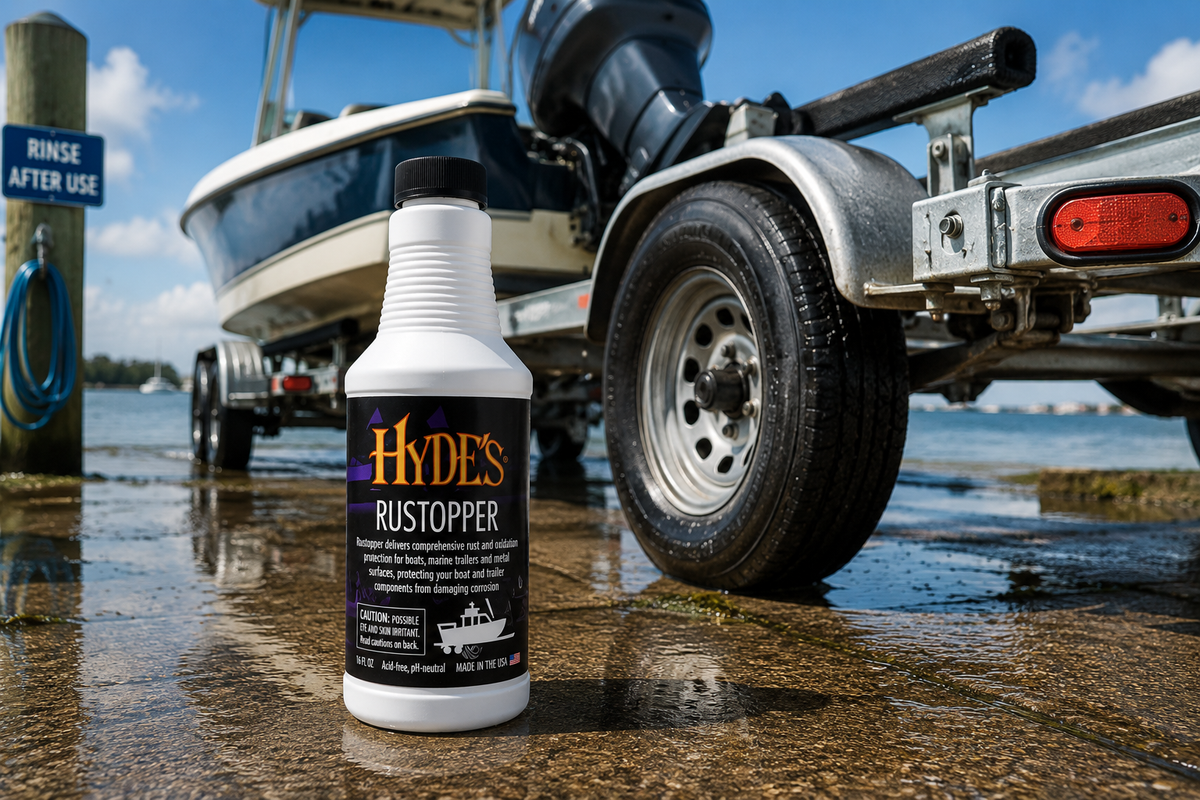
Where Rustopper for Boats & Trailers Fits In
Hyde's Serum originally developed Rustopper to solve the rapid oxidation that appears on automotive brake rotors after washing.
But the underlying problem isn't exclusive to cars.
Metal exposed to water, salt and harsh environments needs protection regardless of what it's attached to.
That's why Rustopper is also available specifically for Boats & Trailers.
Rustopper for Boats & Trailers is designed to provide rust and oxidation protection for appropriate metal surfaces exposed to moisture, salt and harsh conditions during regular use or storage.
The formula is acid-free and pH-neutral and is designed for appropriate metal, chrome and painted surfaces when used according to the label directions.
It fits naturally into the routine you've already established:
Clean. Rinse. Protect.
Shop Hyde's Serum Rustopper for Boats & Trailers
How to Apply Rustopper for Boats & Trailers
Application is intentionally simple.
After washing appropriate metal surfaces:
- Rinse thoroughly.
- While the surface is still wet, spray Rustopper evenly onto the appropriate metal surfaces.
- Allow the treated surfaces to dry completely.
- Wipe away any excess as needed.
- For hinges and moving parts, apply the appropriate lubricant afterward if required.
For best results, apply on cool surfaces in the shade.
Always follow the complete instructions and precautions on the product label.
Rustopper is designed to complement proper marine maintenance, not replace manufacturer-required lubrication, brake maintenance, sacrificial anodes or structural inspections.
Storage Is Part of Corrosion Prevention Too
A trailer may spend a few hours in the water and weeks sitting still.
That makes storage conditions important.
Before longer-term storage:
- Thoroughly remove salt and grime
- Inspect exposed metal
- Address developing surface corrosion
- Protect appropriate metal surfaces
- Lubricate components where required
- Check that water can drain rather than collect
- Inspect brakes and brake components
- Check wheel bearings according to the manufacturer's maintenance schedule
- Inspect tires and tire pressure
- Look over the winch, safety chains and coupler
A little attention before storage makes the next launch easier and gives corrosion less time to work unnoticed.
Five Marine Corrosion Mistakes Worth Avoiding
1. Waiting Until You Get Home to Think About Salt
When freshwater wash-down facilities are available at the ramp or marina, use them.
The sooner salt is removed, the better.
2. Rinsing Only the Parts You Can Easily See
The underside of the trailer experiences the same water you just launched into.
Get underneath it.
3. Assuming an Aluminum Trailer Can't Have Corrosion Problems
The frame may be aluminum.
The entire trailer isn't.
Brakes, springs, axles, fasteners, chains and hardware still require attention.
4. Treating Corrosion Protection as a Repair
A protective product can help prevent or reduce future oxidation.
It can't restore a badly rusted structural component.
5. Forgetting About Freshwater
Saltwater is harsher, but freshwater trailers still benefit from rinsing, inspection and routine protection.
Frequently Asked Questions About Boat and Trailer Rust
How do I prevent rust on a boat trailer?
Start by rinsing the trailer thoroughly with freshwater after use, particularly after saltwater exposure. Inspect brakes, axles, springs, fasteners and other metal components regularly, then protect appropriate exposed metal surfaces as part of your maintenance routine.
Should I rinse my boat trailer after every saltwater launch?
Yes. Freshwater rinsing after saltwater exposure is widely recommended because salt accelerates corrosion of trailer components.
Do I need to rinse a trailer after freshwater use?
It's still a good practice. Freshwater is less aggressive than saltwater, but sediment, dirt and moisture can remain around brakes and other components.
Can galvanized boat trailers rust?
Galvanized steel has a protective zinc coating, but damage to that coating and long-term exposure can eventually leave areas vulnerable. Other components on the trailer may also be made from unprotected materials.
Can aluminum boat trailers rust?
Aluminum doesn't develop the familiar red iron oxide associated with steel, but it can corrode. More importantly, an aluminum trailer still uses many non-aluminum components that may be vulnerable to rust and corrosion.
What parts of a boat trailer should I inspect for corrosion?
Pay particular attention to brakes, axles, springs, U-bolts, brackets, safety chains, winch hardware, couplers, jacks, fasteners and structural areas of the frame.
Is surface rust on a trailer dangerous?
Not necessarily. Light surface oxidation and deep structural corrosion are different. Heavy scaling, deep pitting, rust-through, cracking or significant material loss should be evaluated professionally.
How quickly does saltwater cause corrosion?
Saltwater creates a highly corrosive environment and should be removed as soon as practical. Don't intentionally leave salt deposits on the trailer between trips.
Can I use Rustopper after rinsing my boat trailer?
Rustopper for Boats & Trailers is designed to be applied to appropriate metal surfaces after washing and rinsing while the surfaces are still wet. Follow the product label for complete application instructions.
Does Rustopper replace grease or marine lubricant?
No. Moving parts, bearings and other components still require the appropriate lubrication and maintenance specified by their manufacturers.
Does Rustopper replace sacrificial anodes?
No. Sacrificial anodes are part of an engineered system used to protect certain submerged metals from galvanic corrosion. Rustopper doesn't replace them.
Can Rustopper repair existing rust?
Rustopper is intended for corrosion prevention. Significant existing corrosion may require cleaning, repair, refinishing or component replacement depending on its severity.
Using Your Boat Trailer in Saltwater?
Saltwater creates especially demanding conditions for boat trailers because salt residue can remain on metal components even after the visible water has dried. If you regularly launch in saltwater, a consistent post-launch routine can help reduce unnecessary rust and corrosion.
Our Boat Trailer Rust Prevention After Saltwater Launches guide explains what to rinse, dry, inspect and protect after retrieving your boat, along with areas of the trailer that deserve extra attention.
Protect the Trailer That Protects Your Boat
Boat owners naturally spend most of their attention on the boat.
The trailer usually gets noticed when something goes wrong.
That's backwards.
Your trailer carries thousands of pounds down the highway, repeatedly enters an environment that's hostile to metal, then sits quietly until you need it again.
A good corrosion-prevention routine doesn't need to consume your weekend.
Rinse away salt and contamination.
Look carefully at the components that matter.
Maintain brakes, bearings and moving parts according to their manufacturers' requirements.
Protect appropriate exposed metal before corrosion gets established.
Then do it again after the next trip.
Rinse. Inspect. Protect.
It's a small routine that can help protect the equipment responsible for getting your boat safely to and from the water.
Protect Your Boat & Trailer With Rustopper
Continue Learning
If you also care for cars, learn why brake rotors can turn orange almost immediately after washing and how to reduce post-wash oxidation.
Why Brake Rotors Rust After Washing and How to Prevent It
More Hyde's Serum Rust Prevention Guides are coming for:
Motorcycles: How to Prevent Motorcycle Rust After Washing, Rain and Storage
Bicycles: How to Prevent Rust on Bicycle Disc Brakes, Chains and Drivetrains

Share:
Why Your Brake Rotors Rust After Washing (and How to Prevent It)
How to Prevent Motorcycle Rust After Washing, Rain and Storage