

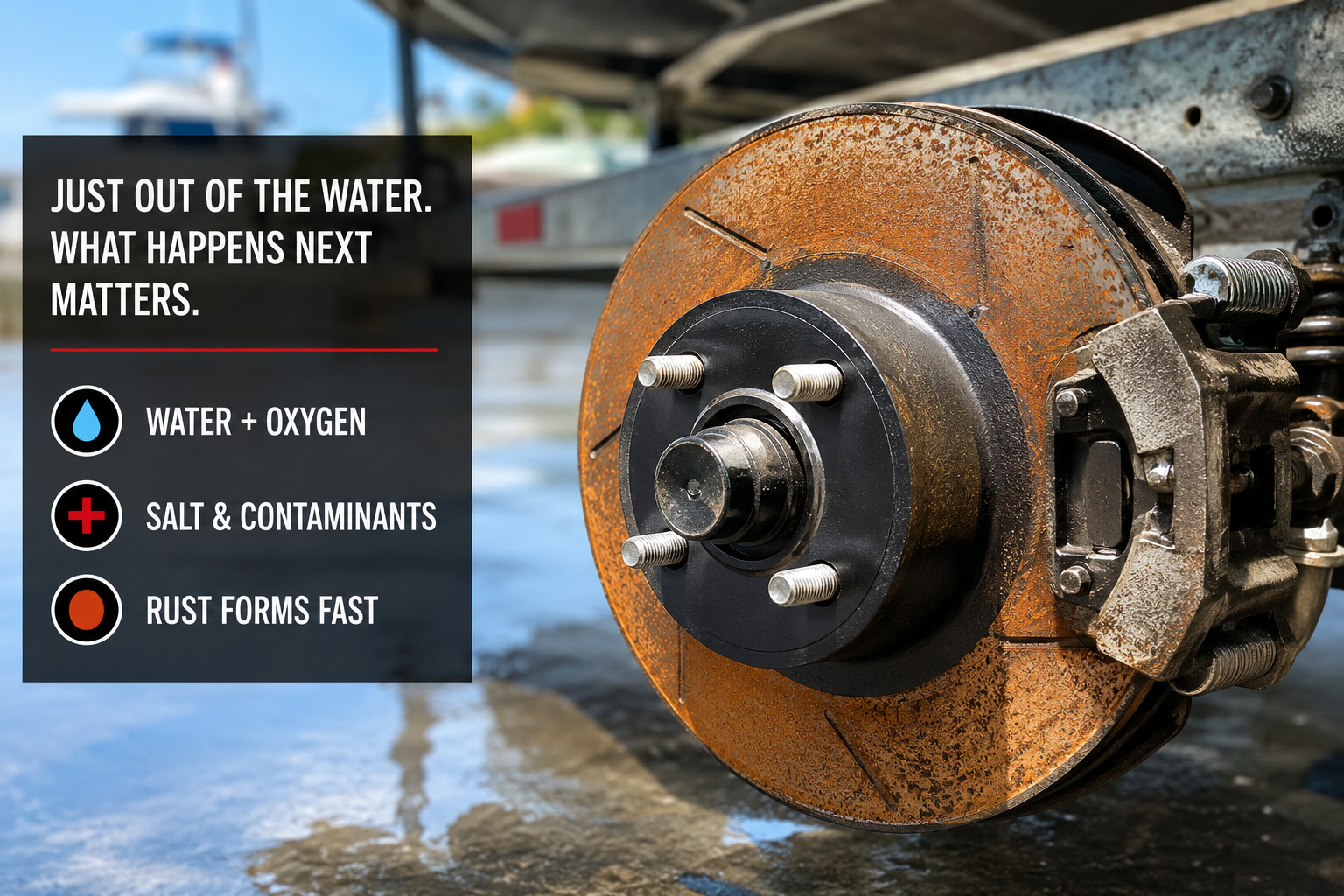
You retrieve your boat, pull the trailer out of the water, and everything looks normal.
A few hours later, or the next morning, you look through the trailer wheel and see something that wasn't there before:
Orange rust covering the brake rotor.
For boat owners, it can be surprising how quickly a clean-looking trailer brake rotor can change after a launch.
The reason is fairly straightforward. Boat trailer disc brakes operate in an unusually demanding environment. The rotors may be repeatedly submerged in water, exposed to road contamination, left wet while the boat is in use, submerged again during retrieval, and then parked while moisture evaporates.
Add saltwater to that cycle and the corrosion environment becomes considerably more aggressive.
But an orange rotor does not automatically mean the brakes are ruined.
Light surface oxidation and serious brake corrosion are very different things. Understanding that difference, and knowing what to do after launching, can help you maintain your trailer properly and recognize when corrosion deserves professional attention.
Why Do Boat Trailer Brake Rotors Rust?
Many brake rotors contain iron-rich materials that can oxidize when exposed to water and oxygen.
A boat trailer makes that exposure almost unavoidable.
During a typical boating trip, the trailer may experience:
Launch → submersion → wet storage → retrieval → submersion again → towing → drying
The brake rotors sit low on the trailer and may be directly exposed to water during both launching and retrieval.
Once the trailer comes out of the water, a thin layer of moisture can remain on the exposed rotor surface.
As that wet surface encounters oxygen, oxidation can begin.
That's the orange or brown discoloration you may notice on the rotor afterward.
Why Can the Rotors Turn Orange So Quickly?
Brake rotor surfaces are particularly noticeable because their friction surfaces are exposed.
Unlike a painted trailer frame or another coated component, the portion of a conventional brake rotor contacted by the brake pads must remain a functional friction surface.
That means you may notice oxidation on the rotor face before you notice corrosion elsewhere on the trailer.
The conditions after retrieval can also be favorable for oxidation:
- The rotor is wet.
- Oxygen is readily available.
- Water may remain around the braking components.
- Humidity may slow drying.
- Dirt or other contamination may be present.
- In marine environments, dissolved salts may remain on the components after the visible water disappears.
The result can be a surprisingly fast change from metallic gray to orange-brown surface oxidation.
Saltwater Makes the Problem More Aggressive
Saltwater exposure deserves particular attention.
Those dissolved salts matter for corrosion.
NOAA technical guidance explains that water containing dissolved salts is a better electrolyte than relatively pure water, which can increase electrochemical corrosion activity. Marine environments can therefore be substantially more demanding on susceptible metals than ordinary freshwater exposure.
That's one reason trailer manufacturers offer braking components specifically designed for marine applications.
Dexter's Kodiak trailer disc brake systems, for example, are used in marine applications and are available with different corrosion-resistant materials and coatings. Dexter specifically identifies stainless steel as an additional safeguard against rust in saltwater applications.
In other words, manufacturers engineer around marine corrosion because it is a real operating condition—not simply a cosmetic concern.
Can Boat Trailer Rotors Rust After a Freshwater Launch?
Yes.
Saltwater generally presents the more aggressive corrosion environment, but freshwater doesn't eliminate the basic ingredients required for oxidation.
A freshwater launch can still leave brake rotors wet.
Moisture can remain on the rotor surface and around brake components, particularly when a trailer is parked immediately after retrieval.
Freshwater may also contain:
- Minerals
- Sediment
- Organic material
- Road contamination
- Other dissolved substances
Even relatively clean water can leave susceptible metal exposed to moisture and oxygen.
So while saltwater boaters need to be especially diligent, freshwater trailer brakes aren't immune to rust.
Is Light Rust on a Boat Trailer Brake Rotor Normal?
A light orange film on the rotor face after water exposure is not necessarily evidence that the braking system has failed.
In fact, trailer brake manufacturer Dexter specifically distinguishes between light rotor rust and more concerning brake problems.
In its boat trailer maintenance guidance, Dexter describes light rust that polishes off during the first few stops as normal, while identifying rust that does not polish off, dragging/stuck wheels and abnormal brake temperatures as conditions that deserve attention.
That distinction is extremely important.
Light surface oxidation may look like:
- A thin orange film
- Relatively uniform discoloration
- Rust appearing shortly after water exposure
- Surface oxidation that diminishes with normal brake use
More concerning corrosion may involve:
- Heavy scaling
- Deep pitting
- Flaking metal
- Significant roughness
- Rust that remains after normal brake operation
- Uneven or badly deteriorated rotor surfaces
- Corroded calipers or mounting hardware
- Damaged brake lines
- Sticking or dragging brakes
- Unusual braking behavior
The appearance of orange coloration alone doesn't tell the whole story.
Condition and brake performance matter.
When Should You Worry About Rust on Boat Trailer Brakes?
Trailer brakes are safety-critical components.
If corrosion appears substantial—or you're uncertain about the condition of the braking system—have the brakes inspected by a qualified trailer or marine service professional.
Pay particular attention to symptoms such as:
- Deeply pitted rotor surfaces
- Heavy rust scaling
- A rotor surface that remains severely corroded after use
- Sticking calipers
- A wheel that remains unusually hot
- Brake fluid leaks
- Heavily corroded brake lines
- Damaged mounting hardware
- Uneven braking
- Reduced braking performance
- Unusual noise or vibration
- Components that appear structurally deteriorated
Rust-prevention products are intended to help prevent or reduce future oxidation.
They do not restore metal that has already experienced significant deterioration, and they are not substitutes for brake repair or replacement.
Why Marine Trailer Brakes Use Special Materials and Coatings
If you've ever wondered why some boat trailer brakes cost considerably more than ordinary trailer components, corrosion resistance is part of the answer.
Dexter offers several material and coating options for trailer disc brakes intended for different environments.
Its technical overview of trailer disc brake coatings and materials describes options including stainless steel, aluminum, KodaGuard and Gal-Dex coatings.
For demanding environments, corrosion resistance isn't merely about appearance.
Brake components must continue functioning despite exposure to water, road contamination and, in marine applications, potentially salt.
However, corrosion-resistant does not mean maintenance-free.
Even a trailer equipped with marine-grade components should still be inspected and maintained according to its manufacturer's requirements.
Why the Rotor Face Can Rust Even When Other Brake Parts Look Fine
This confuses many boat owners.
You may have corrosion-resistant calipers and brackets yet still notice orange coloration across the rotor friction surface.
The reason is that different components can use different materials, coatings and surface treatments.
The rotor also has a unique job.
Its friction surface must interact with the brake pads every time the brakes are applied. That functional surface has different requirements from a painted frame rail or a protected mounting bracket.
So don't judge the condition of the entire braking system solely by whether the rotor face is orange.
Inspect the complete assembly:
- Rotor
- Caliper
- Pads
- Mounting bracket
- Brake lines and hoses
- Fasteners
- Hub area
- Surrounding hardware
What Should You Do After Pulling a Boat Trailer Out of Saltwater?
For a complete trailer-wide routine, see our guide to boat trailer rust prevention after saltwater launches.
For the braking system specifically, the basic approach is straightforward.
1. Rinse Away Salt and Contamination
After saltwater use, thoroughly rinse appropriate trailer and brake components with clean freshwater according to the trailer and brake manufacturer's recommendations.
The goal is to remove salt and other contamination rather than allowing it to remain as the water evaporates.
Pay attention to the complete brake assembly rather than only spraying the visible rotor face.
2. Inspect While You're There
Rinsing gives you an excellent opportunity to look at the brakes.
Check for:
- Unusual rust accumulation
- Damaged brake lines
- Fluid leaks
- Loose or questionable hardware
- Abnormal pad wear
- Sticking components
- Heavy corrosion around the caliper or bracket
A quick visual inspection after use can help you notice a developing problem before the next towing trip.
3. Follow the Brake Manufacturer's Maintenance Requirements
Different trailer braking systems have different service procedures.
Some marine brake systems incorporate particular flushing procedures, materials or corrosion-resistant components.
Follow the instructions supplied by the trailer, axle and brake manufacturers.
A general corrosion-prevention routine should supplement manufacturer maintenance—not replace it.
4. Protect Appropriate Metal Surfaces
After cleaning and rinsing, corrosion protection can be incorporated where appropriate and according to the product directions.
The goal is prevention:
reduce the opportunity for oxidation to establish itself during repeated wet/dry cycles and storage.
Where Rustopper for Boats & Trailers Fits
Hyde's Serum originally developed Rustopper around a problem familiar to automotive enthusiasts: exposed brake rotors can develop visible flash rust rapidly after washing.
Boat trailer brake rotors encounter an even more demanding version of the wet-metal problem because they may be repeatedly submerged during normal use.
That's where Rustopper for Boats & Trailers fits into a broader maintenance routine.
Rustopper is designed to help prevent flash rust and oxidation on appropriate metal surfaces exposed to moisture and harsh conditions when used according to the product directions.
It is intended as a preventive maintenance product.
It does not replace:
- Brake inspections
- Freshwater rinsing after saltwater use
- Brake-system flushing where required
- Brake fluid maintenance
- Proper lubrication of components that require lubrication
- Manufacturer-specified servicing
- Replacement of worn or badly corroded components
Think of the process as:
Rinse → Inspect → Protect → Maintain
Shop Hyde's Serum Rustopper for Boats & Trailers
Can You Simply Drive the Trailer to Remove Rotor Rust?
Light surface oxidation on a rotor friction surface may diminish as the brakes operate.
As noted above, Dexter identifies light rust that polishes off during the first few stops as normal in its boat-trailer maintenance guidance.
But that doesn't mean every rusty rotor should simply be ignored.
Braking should never be used as a substitute for inspection when corrosion appears significant.
If rust is heavy, deeply pitted, uneven, persistent, or accompanied by questionable braking performance, the appropriate response is inspection—not simply hoping normal braking will fix it.
What About a Trailer That Sits for Weeks Between Launches?
Storage can make corrosion prevention even more important.
A boat trailer may spend only a short period submerged but then sit unused for days or weeks.
During that time, residual moisture and contamination can remain around components.
Before storing the trailer:
- Remove salt and contamination.
- Inspect the brakes.
- Address abnormal corrosion.
- Apply appropriate corrosion protection where specified.
- Maintain components according to manufacturer instructions.
- Make sure water can drain rather than remain trapped.
- Avoid putting contaminated equipment into long-term storage without cleaning it first.
For a broader trailer-maintenance strategy covering brakes, axles, springs, fasteners, frames and other components, read How to Prevent Rust and Corrosion on Boats and Boat Trailers.
Saltwater vs. Freshwater Boat Trailer Brake Maintenance
Both environments deserve maintenance.
But they aren't identical.
Freshwater
Freshwater can still leave brake components wet and contribute to surface oxidation.
Remove sediment and contamination, allow appropriate components to drain, inspect the brakes, and follow the manufacturer's maintenance recommendations.
Saltwater
Saltwater adds dissolved salts to the equation and creates a substantially more aggressive corrosion environment.
That makes prompt freshwater rinsing and regular inspection particularly important.
If your trailer is used primarily in saltwater, corrosion-resistant brake components and a disciplined post-launch maintenance routine become especially valuable.
Frequently Asked Questions
Why do my boat trailer brake rotors turn orange after launching?
The orange coloration is commonly associated with oxidation of the exposed rotor surface. Launching leaves the brake assembly wet, and susceptible metal can begin oxidizing as it remains exposed to moisture and oxygen.
Can boat trailer brake rotors rust overnight?
Visible surface oxidation can develop relatively quickly under favorable conditions. Water exposure, humidity, contamination, rotor material and salt can all influence how quickly oxidation becomes visible.
Is rust on boat trailer brake rotors normal?
Light surface rust can occur after water exposure. Dexter notes that light rust that polishes off during the first few stops can be normal. Heavy, persistent, deeply pitted or performance-affecting corrosion is a different matter and should be inspected.
Why is saltwater worse for boat trailer brakes?
Saltwater contains dissolved ions that make it a more effective electrolyte, increasing the potential for electrochemical corrosion. This is one reason marine brake manufacturers offer corrosion-resistant materials and coatings specifically for saltwater environments.
Should I rinse boat trailer brakes after launching in saltwater?
Freshwater rinsing is an important part of post-saltwater trailer maintenance. Follow the trailer and brake manufacturer's instructions for cleaning and flushing the braking system.
Can freshwater make boat trailer rotors rust?
Yes. Freshwater doesn't contain the same concentration of salts as seawater, but it still wets susceptible metal. Surface oxidation can therefore occur after freshwater launches as well.
Will braking remove rust from a boat trailer rotor?
Light surface oxidation on the rotor friction surface may diminish during normal braking. However, significant, persistent or deeply pitted corrosion should not simply be driven on in the hope that braking will remove it.
When should rusty boat trailer brakes be inspected?
Have the braking system inspected if you see heavy scaling, deep pitting, damaged brake lines, leaks, sticking components, abnormal temperatures, significant deterioration or any change in braking performance.
Are stainless steel boat trailer brakes rust-proof?
Stainless steel offers strong corrosion resistance, particularly for marine applications, but no safety-critical braking system should be considered maintenance-free. Components still require inspection and manufacturer-specified maintenance.
Does Rustopper repair an already corroded brake rotor?
No. Rustopper is intended for rust and oxidation prevention. It does not restore metal that has already experienced significant corrosion or deterioration.
Does Rustopper replace freshwater rinsing after saltwater use?
No. Remove salt and contamination first. Rustopper is designed to fit into a proper cleaning and corrosion-prevention routine rather than replace it.
Sources & Further Reading
Dexter Group — Kodiak Disc Brakes
Dexter's Kodiak line provides useful manufacturer information about disc brakes used on boat trailers, including corrosion-resistant coatings and materials intended for marine and saltwater applications.
Read Dexter's Kodiak Disc Brake information
Dexter Group — Trailer Disc Brake Coating and Material Options
Dexter explains the different corrosion-resistant materials and coatings available for trailer disc braking systems, including stainless steel, aluminum and specialized coatings for corrosive environments.
Read Dexter's technical guide to trailer disc brake materials
NOAA — Why Is the Ocean Salty?
NOAA provides background on seawater salinity and the dissolved ions that make marine environments fundamentally different from ordinary freshwater exposure.
Read NOAA's explanation of seawater salinity
Protect the Brakes That Get Your Boat Home
Boat trailer brake rotors live in an environment automotive brakes rarely experience.
They may be deliberately submerged, pulled out wet, exposed to salt, submerged again, towed down the highway and then parked for days or weeks.
Seeing orange surface oxidation after a launch doesn't automatically mean the brakes are ruined.
But it shouldn't be an excuse to ignore them either.
The better approach is straightforward:
Rinse after exposure.
Inspect the complete braking system.
Protect appropriate metal surfaces.
Follow the manufacturer's maintenance schedule.
Take significant corrosion seriously.
That routine helps separate ordinary surface oxidation from the corrosion problems that actually deserve attention.
And if your trailer regularly sees saltwater, make corrosion prevention part of every trip—not something you start thinking about after the rust becomes difficult to ignore.
For your complete post-saltwater routine, read Boat Trailer Rust Prevention After Saltwater Launches.
For a broader guide covering the entire trailer, read How to Prevent Rust and Corrosion on Boats and Boat Trailers.
Shop Rustopper for Boats & Trailers

Share:
Why Does My Bike Chain Rust After Washing? Causes, Prevention & What to Do