
A vehicle leaves the detail bay clean, dry, and ready for the sales floor. A few hours later, orange surface rust begins appearing across the brake rotors.
For automotive and motorcycle dealerships, it is a small detail that can undermine an otherwise careful vehicle preparation process.
Brake rotor flash rust can develop quickly after washing because bare iron-containing surfaces are exposed to water and oxygen. While light surface oxidation on brake rotors is common, it is not necessarily the appearance a dealership wants on freshly detailed inventory, particularly when a vehicle is being photographed, displayed, or prepared for customer delivery.
For dealership detail departments, reconditioning teams, and professional detailers, the better approach is to consider rust prevention as part of the wash process itself.
Why Brake Rotors Rust So Quickly After Washing
Brake rotors operate with largely exposed metal surfaces. During a vehicle wash, those surfaces get wet along with the wheels, tires, and surrounding components.
Once water and oxygen reach the rotor surface, oxidation can begin. The familiar orange color that sometimes appears shortly after washing is commonly referred to as flash rust.
Humidity, rain, road salt, coastal conditions, and vehicles remaining stationary after washing can add to the challenge.
For a vehicle owner washing one car, this may be little more than an annoyance. A dealership may be washing and preparing dozens of vehicles every week, which turns the same issue into a recurring part of inventory maintenance.
A freshly detailed vehicle can look excellent when it leaves the wash area, yet visible orange oxidation may begin appearing behind the wheels before a customer ever sees it.
For a deeper look at why this occurs, see our Complete Brake Rotor Rust Prevention Guide.
Why Flash Rust Matters on Dealership Inventory
Vehicle presentation influences first impressions.
Modern wheel designs often expose a substantial portion of the brake rotor. On performance cars, luxury vehicles, trucks, and other vehicles with open wheels, even relatively light rotor oxidation can be easy to see.
This becomes particularly relevant during several stages of dealership operations.
Inventory photography is one example. Online listings often provide a customer's first detailed look at a vehicle. Clean wheels surrounding visibly orange brake rotors can detract from otherwise polished photographs.
Used-vehicle reconditioning presents another opportunity. A dealership may invest significant time cleaning, correcting, and preparing a trade-in, only to have post-wash rotor rust appear after the vehicle reaches the lot.
Then there is customer delivery. The final wash is often performed shortly before a buyer receives the vehicle. At that point, every visible detail contributes to the delivery experience.
Rust prevention can also be useful during routine lot washing and preparation of vehicles that may remain stationary for extended periods.
Motorcycle Dealerships Have the Same Problem, With More on Display
Motorcycles present a related challenge because so much of the machine is visible.
Brake rotors, drivetrain components, fasteners, and exposed metal surfaces contribute directly to the motorcycle's overall appearance. There is less bodywork hiding mechanical components from view.
A motorcycle that has been washed for showroom display, online photography, or customer delivery may therefore show moisture-related oxidation in highly visible areas.
Used motorcycles can require particularly careful preparation. Buyers often inspect exposed components closely, and condition is part of the purchase decision.
The objective is not to make unrealistic promises about eliminating corrosion. It is to incorporate appropriate preventive care into the dealership's normal cleaning and maintenance process.
Dealership teams looking for motorcycle-specific information can read our Complete Motorcycle Rust Prevention Guide.
Make Prevention Part of the Wash Process
The most practical dealership procedures are usually the ones that fit into work already being performed.
Rust prevention should be no different.
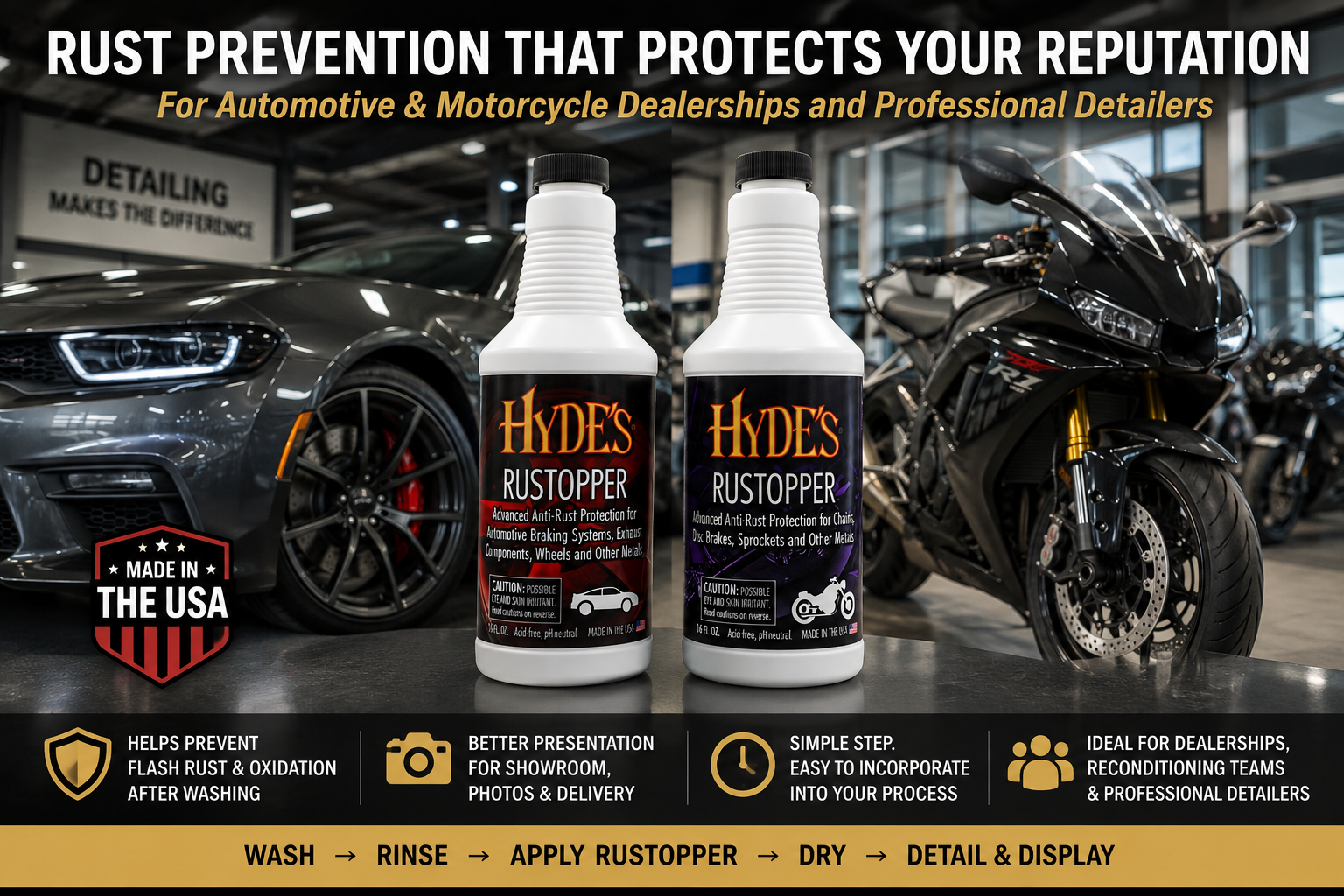
Hyde's Serum Rustopper is designed to help prevent flash rust and oxidation after washing or water exposure. For automotive applications, it can be incorporated into the post-wash process for brake rotors and appropriate exposed metal surfaces according to the product directions.
The basic workflow is straightforward:
Wash → Rinse → Apply Rustopper → Dry → Final Detail
Rustopper is applied at the appropriate point after washing and rinsing while designated surfaces are still wet, following the directions on the product label. Treated surfaces are then allowed to dry completely, with excess addressed as directed.
This makes rust prevention an additional step within the existing vehicle-preparation process rather than a separate corrective procedure after visible oxidation has already appeared.
Automotive operations can learn more through Automotive Rust and Corrosion Protection, while motorcycle departments can explore Motorcycle Rust and Corrosion Protection.
A Practical Consideration for Reconditioning and Detail Teams
Dealership detailing is different from enthusiast detailing at home.
Time matters. Consistency matters. A process has to work across multiple vehicles and employees.
That is why the value of a post-wash rust-prevention step is less about adding another detailing product and more about addressing a predictable problem at the point where it occurs.
If brake rotors regularly develop visible flash rust after washing, addressing that issue during the wash process can make more sense than dealing with the appearance afterward.
The same principle applies to independent professional detailers. Customers sometimes notice orange rotors shortly after a wash and wonder why their freshly detailed vehicle already appears rusty.
Understanding flash rust gives the detailer an opportunity to explain what is happening and incorporate appropriate preventive care into a more complete detailing process.
Prevention Is Different From Rust Removal
This distinction is important.
Rustopper is designed to help prevent flash rust and oxidation. It should not be confused with a product intended to remove established rust or reverse existing corrosion.
The objective is preventive maintenance.
For dealerships, that means incorporating the product into an appropriate wash and detailing routine before the familiar orange appearance develops.
As with any professional-use process, employees should read and follow the complete product-label directions and precautions for the application and surfaces being treated.
A Small Detail That Can Improve Vehicle Presentation
A dealership cannot control every environmental condition its inventory encounters. Vehicles get wet. Motorcycles encounter humidity. Inventory sits outside. Weather changes.
What a dealership can control is its preparation process.
If brake rotor flash rust regularly appears after vehicles are washed, rust prevention can become another finishing step alongside drying, tire dressing, glass cleaning, and final inspection.
It is a relatively small part of vehicle preparation, but those small details collectively determine how finished inventory looks when a customer sees it.
For dealerships and professional detailers managing multiple vehicles, Hyde's Serum Rustopper is available in 16 fl oz bottles and gallon sizes for individual and professional applications.
Explore Hyde's Serum Rustopper →
Contact Hyde's Serum About Dealership and Professional Use →

Share:
How to Prevent Rust on Bicycle Chains, Disc Brakes and Drivetrains
Is Rust on Brake Rotors Normal? Causes, When to Worry, and Prevention