
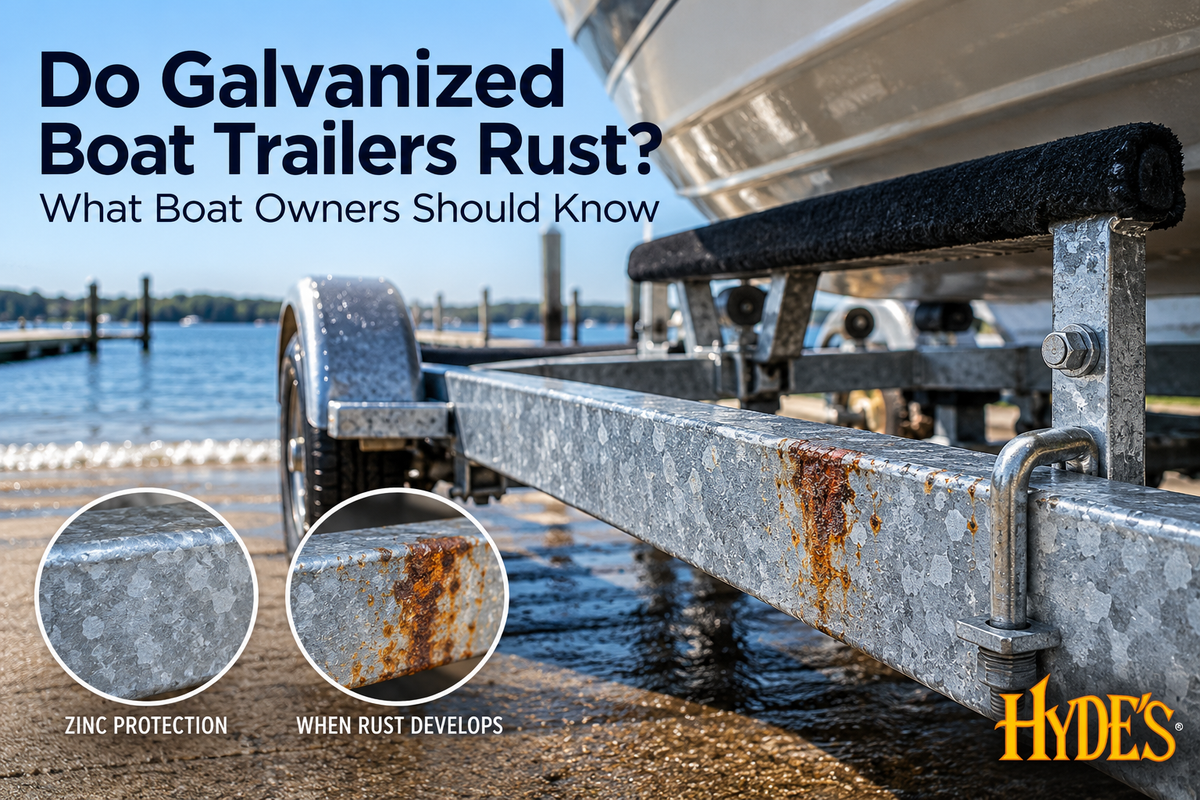
Yes, galvanized boat trailers can rust.
Galvanizing provides excellent corrosion protection, which is one reason galvanized steel is widely used for boat trailers, especially in saltwater environments. But a galvanized trailer is not rust-proof.
A galvanized boat trailer is still made primarily from steel. The difference is that the steel has been coated with zinc. That zinc coating protects the steel from moisture and other corrosive conditions and can continue protecting small areas even if the coating is scratched.
Over time, the zinc itself can weather, corrode, wear away, or become damaged. If enough protection is lost, the steel underneath can begin to rust.
Knowing how galvanizing works makes it much easier to understand what you are seeing on an older boat trailer and whether it is normal weathering or something that needs attention.
What Does Galvanized Mean on a Boat Trailer?
When a boat trailer is described as galvanized, it generally means that steel components have been coated with zinc to improve corrosion resistance.
A common process for structural trailer components is hot-dip galvanizing. Fabricated steel is immersed in molten zinc, which creates a metallurgically bonded coating on the steel.
This is different from simply painting steel with a silver-colored coating.
According to the American Galvanizers Association, hot-dip galvanizing protects steel through a combination of barrier protection, cathodic protection, and the formation of a protective zinc patina.
Each of these plays a role in the long service life associated with galvanized steel.
How Does Zinc Protect the Steel?
The first layer of protection is straightforward. Zinc creates a physical barrier between the steel and its environment.
Moisture, oxygen, salt, and other contaminants have a harder time reaching the steel when an intact zinc coating is in the way.
Galvanizing also provides another type of protection that ordinary barrier coatings cannot provide.
Zinc provides sacrificial protection
Zinc is more electrochemically active than steel. When zinc and exposed steel are electrically connected in the presence of moisture, the zinc can corrode preferentially.
This is known as cathodic or sacrificial protection.
It is one reason a small scratch in galvanized steel does not necessarily behave the same way as a scratch through paint on ordinary steel.
The American Galvanizers Association explains how zinc provides cathodic protection to small areas of exposed steel.
There is an important limitation, however. The zinc is consumed as it provides this protection. The protection does not last forever if the zinc continues to be depleted.
What Is Zinc Patina?
New galvanized steel often has a bright or mottled silver appearance. As it is exposed to air and moisture, the zinc surface begins to react with its environment.
These reactions eventually produce a relatively stable layer of zinc corrosion products commonly referred to as zinc patina.
The patina helps slow further corrosion of the zinc beneath it and contributes to the long service life of properly galvanized steel.
This process also explains why a galvanized trailer may look different after several years of use.
Why Does a Galvanized Trailer Turn Dull Gray?
A galvanized trailer does not have to remain shiny to remain protected.
Freshly galvanized steel can have a bright, mottled, spangled, or matte appearance. With normal weathering, the surface often develops a more uniform gray finish.
The American Galvanizers Association discusses variations in galvanized coating appearance and notes that weathering tends to produce a more uniform matte-gray surface.
For a boat owner, the practical point is that a dull gray trailer is not necessarily a rusty trailer.
The appearance of galvanized steel naturally changes as it ages.
Why Can a Galvanized Boat Trailer Still Rust?
Galvanizing can greatly extend the life of steel, but the zinc coating is not permanent or indestructible.
Several things can reduce its ability to protect the steel.
Normal weathering
The zinc coating is gradually consumed as it protects the steel. How quickly that occurs depends on coating thickness and the environment in which the trailer is used and stored.
Scratches and abrasion
Road debris, gravel, tools, loading equipment, tie-downs, and normal trailer use can damage the coating.
Small areas may continue receiving protection from nearby zinc, but larger areas of damage deserve attention.
Cutting, drilling, and grinding
Modifications can physically remove the galvanized coating and expose steel that was previously protected.
Welding and repairs
Repairs or modifications involving heat can affect the original coating. Proper repair of damaged galvanizing may be required afterward.
Marine exposure
Boat trailers routinely encounter water, repeated wet and dry cycles, road contamination, and, in many cases, saltwater. These conditions place greater demands on corrosion-protection systems.
White Corrosion and Red Rust Are Not the Same Thing
One of the most useful things a galvanized trailer owner can learn is the difference between corrosion of the zinc and corrosion of the underlying steel.
White or gray corrosion
Galvanized steel can develop white, gray, or chalky deposits.
One condition commonly associated with galvanized steel is called wet-storage stain, sometimes referred to as white rust.
This involves corrosion of the zinc surface rather than conventional red rust forming on the steel underneath.
That does not mean heavy white corrosion should always be ignored. Significant zinc corrosion can consume some of the coating that is protecting the steel.
It does mean that white corrosion and red steel rust are not the same process.
Red or brown rust
Red or brown rust generally indicates corrosion involving iron in the underlying steel.
On a galvanized component, this may occur where the zinc coating has been damaged, worn away, removed, or sufficiently consumed.
Common locations can include areas affected by abrasion, modifications, repairs, or long-term exposure.
A small isolated rust spot is different from widespread corrosion, but visible red rust on a galvanized structural component is worth investigating.
Can Galvanized Steel Protect a Scratch?
To a limited extent, yes.
This is sometimes described as galvanized steel being "self-healing," but that phrase can be misleading. Zinc does not physically grow back over damaged steel.
Instead, zinc surrounding a relatively small exposed area can continue to provide cathodic protection.
The American Galvanizers Association explains cathodic protection of bare spots and how nearby zinc can help protect small exposed areas.
The size of the damaged area matters. Zinc protection should not be viewed as a reason to ignore substantial coating damage.
What Happens if You Drill, Cut, or Weld a Galvanized Trailer?
Drilling, cutting, grinding, and welding can damage or remove the original zinc coating.
If the work exposes a significant area of bare steel, the original corrosion-protection system should be properly restored.
There are established procedures for repairing damaged hot-dip galvanized coatings.
The American Galvanizers Association provides guidance for repairing hot-dip galvanized steel, including recognized repair methods associated with ASTM A780.
This is an important distinction for trailer owners.
A general corrosion-prevention product is not a substitute for repairing a galvanized coating that has been substantially removed or damaged.
If structural work has been performed on the trailer, follow the trailer manufacturer's recommendations and an appropriate galvanized-coating repair procedure.
Are Galvanized Trailers Good for Saltwater?
Yes. Galvanized steel is widely used for saltwater boat trailers because of its corrosion resistance.
Trailer manufacturers specifically offer galvanized construction for marine use.
For example, ShoreLand'r offers hot-dip galvanized trailer finishes for corrosion resistance in marine environments.
Karavan Trailers also identifies galvanized construction as an option for saltwater use.
That does not make a galvanized trailer maintenance-free.
Repeated saltwater exposure, wet and dry cycles, abrasion, and years of service can gradually affect the zinc coating and other trailer components.
If your trailer is regularly launched in saltwater, see our guide to boat trailer rust prevention after saltwater launches.
Why Are My Trailer Brakes Rusting if the Frame Is Galvanized?
The main frame of a boat trailer and the components attached to it do not necessarily use the same materials or corrosion-protection systems.
A trailer can include:
- Brake rotors
- Calipers
- Leaf springs
- Axles
- Fasteners
- Couplers
- Safety chains
- Hubs
- Wheels
- Bunk hardware
- Winch components
Some of these components may be galvanized. Others may use different metals, coatings, or finishes.
This explains why a galvanized trailer frame can remain in good condition while the brake rotors or other components develop visible rust.
Brake rotors are particularly noticeable because the friction surfaces have different requirements from the trailer frame.
If the orange rust you are seeing is primarily on the brakes, read our guide to why boat trailer brake rotors rust after launching.
Can Different Metals Affect Corrosion?
Boat trailers frequently contain more than one type of metal.
When dissimilar metals are electrically connected and exposed to an electrolyte such as water, galvanic corrosion can become a consideration. Marine and saltwater environments make material compatibility especially important.
The American Galvanizers Association discusses dissimilar metals and galvanized steel, including considerations for aggressive environments.
This is one reason replacement hardware should be selected according to the trailer manufacturer's specifications.
A fastener or component that looks corrosion-resistant is not necessarily the correct choice for every location on a boat trailer.
Does Red Rust Mean the Entire Galvanized Coating Has Failed?
No.
A localized red rust spot does not necessarily mean the galvanizing across the entire trailer has failed.
The problem may be limited to an area where the coating was damaged or depleted.
Look closely at the location.
Check for:
- Scratches or gouges
- Abrasion
- Previous repairs
- Drilled holes
- Welded areas
- Impact damage
- Areas that remain wet or collect debris
The extent of the corrosion matters just as much as its color.
One small affected area is very different from widespread rust, deep pitting, or significant loss of steel.
When Should Rust on a Galvanized Trailer Be Taken Seriously?
A boat trailer is load-bearing road equipment, so structural corrosion deserves appropriate attention.
Have the trailer evaluated by a qualified trailer professional if you find conditions such as:
- Deep pitting
- Heavy scaling
- Flaking steel
- Perforation
- Significant loss of metal thickness
- Cracking
- Serious corrosion around structural welds
- Deterioration around suspension mounting points
- Badly corroded springs or axle components
- Significant brake-system corrosion
- Corrosion around the coupler
- Compromised safety-chain attachment points
Surface appearance alone does not always tell you how much structural material remains.
If you are uncertain about the condition of a load-bearing or safety-critical component, professional inspection is the appropriate next step.
Galvanized, Painted, or Aluminum: What Is the Difference?
Boat trailers are commonly available in painted steel, galvanized steel, and aluminum construction.
Each has different characteristics.
Painted steel trailers
Paint protects steel primarily by creating a barrier between the metal and the environment.
If the coating is chipped or damaged and bare steel is exposed, corrosion can begin at that location.
Galvanized steel trailers
Galvanized steel combines a physical zinc barrier with sacrificial protection.
That makes it particularly useful in environments where corrosion resistance is a priority.
Aluminum trailers
Aluminum does not develop red iron rust because it does not contain iron in the same way steel does.
Aluminum can still corrode, however, and an aluminum trailer can contain steel or galvanized components that behave differently from the aluminum frame.
The corrosion behavior of aluminum boat trailers is a separate subject and deserves its own discussion.
How Do You Maintain a Galvanized Boat Trailer?
A properly galvanized frame already has a substantial corrosion-protection system built into it.
Maintenance should focus on preserving that protection and identifying problems early.
Rinse after saltwater exposure
Freshwater rinsing helps remove salt and other contaminants from the trailer and its components.
Inspect the galvanized coating
Look periodically for new red rust, substantial coating damage, deep scratches, modified areas, or unusual corrosion.
Check more than the frame
Inspect brakes, suspension, axles, fasteners, couplers, hubs, and other components that may not have the same protection as the galvanized frame.
Repair damaged galvanizing correctly
If a substantial area of zinc coating has been removed, use an appropriate repair procedure rather than relying solely on a general rust-prevention treatment.
For a broader look at maintaining the complete trailer, see How to Prevent Rust and Corrosion on Boats and Boat Trailers.
Where Does Rustopper for Boats & Trailers Fit?
Rustopper does not replace galvanizing.
It does not restore zinc that has been consumed, re-galvanize damaged steel, or repair structural corrosion.
Rustopper for Boats & Trailers is intended to help prevent rust and oxidation on appropriate exposed metal surfaces as part of regular trailer maintenance.
That can be particularly useful because many components attached to a galvanized trailer do not necessarily have the same corrosion protection as the galvanized frame.
A practical maintenance routine is:
Rinse. Inspect. Protect. Maintain.
Rinse away contamination after marine exposure. Inspect the trailer for developing corrosion or coating damage. Protect appropriate exposed metal surfaces according to product directions. Maintain structural and safety-critical systems according to the trailer and component manufacturers' requirements.
Shop Rustopper for Boats & Trailers

Frequently Asked Questions
Do galvanized boat trailers eventually rust?
Yes. Galvanizing greatly improves the corrosion resistance of steel, but the zinc coating can gradually be consumed, worn away, or damaged. If the underlying steel loses sufficient zinc protection, red rust can develop.
Why is my galvanized trailer turning gray?
A matte-gray appearance can be part of the normal weathering process of galvanized steel. As zinc reacts with the environment, a protective zinc patina develops. Loss of the original bright appearance does not necessarily mean the galvanizing has failed.
What is the white material on my galvanized trailer?
White or chalky deposits can be zinc corrosion products. One condition commonly associated with this appearance is wet-storage stain, also called white rust. It is different from red-brown corrosion of the underlying steel.
Is red rust normal on a galvanized boat trailer?
Red rust indicates corrosion involving iron or steel and should be investigated. It can occur where the zinc coating has been damaged, removed, worn away, or depleted.
Can galvanized steel rust after being scratched?
It can, but nearby zinc can provide sacrificial protection to relatively small exposed areas. The zinc coating does not physically grow back, and substantial damage should be repaired appropriately.
Can damaged galvanizing be repaired?
Yes. Established methods exist for repairing damaged hot-dip galvanized coatings. The American Galvanizers Association provides guidance based on recognized standards including ASTM A780.
Are galvanized trailers suitable for saltwater?
Yes. Galvanized steel is widely used for saltwater boat trailers because of its corrosion resistance. Regular rinsing, inspection, and maintenance are still recommended.
Why do my brake rotors rust when the galvanized frame does not?
Brake rotors and the trailer frame have different functions and may use different materials and protective coatings. Galvanizing the frame does not mean every component attached to the trailer has the same corrosion resistance.
Is a dull galvanized trailer worn out?
Not necessarily. Galvanized steel commonly becomes duller and grayer as it weathers. The condition of the coating and underlying steel is more meaningful than whether the surface remains shiny.
Can Rustopper repair damaged galvanizing?
No. Rustopper is a preventive corrosion product. It does not replace zinc, restore a damaged galvanized coating, or repair structural corrosion.
The Bottom Line
Galvanized boat trailers can rust, but galvanizing provides the steel with several important layers of corrosion protection.
The zinc coating separates the steel from its environment, provides sacrificial protection to small exposed areas, and develops a protective patina as it weathers.
This is why a galvanized trailer can remain serviceable in demanding marine environments for a long time.
It is also why appearance can sometimes be misleading. A dull gray galvanized surface may be normal. White zinc corrosion is different from red iron rust. A small scratch does not necessarily mean the underlying steel will immediately begin rusting.
Galvanizing still has limits. Saltwater exposure, abrasion, modifications, coating damage, and years of service can gradually consume or compromise the zinc. Once enough protection is lost, the underlying steel can begin to corrode.
Regular inspection helps identify those areas before they become larger problems.
For more information about maintaining the complete trailer, read How to Prevent Rust and Corrosion on Boats and Boat Trailers.
If your trailer regularly sees saltwater, also read Boat Trailer Rust Prevention After Saltwater Launches.
Shop Rustopper for Boats & Trailers
Sources and Further Reading
The American Galvanizers Association guide to corrosion protection explains barrier protection, cathodic protection, and zinc patina formation in hot-dip galvanized steel.
The American Galvanizers Association guide to galvanized coating appearance explains why galvanized steel can vary in appearance and become more uniformly gray as it weathers.
The American Galvanizers Association guide to repairing hot-dip galvanized steel discusses recognized approaches for repairing damaged galvanized coatings.
ShoreLand'r boat trailer options provides a trailer manufacturer's perspective on hot-dip galvanized construction for marine environments.
Karavan Trailers' guide to painted, galvanized, and aluminum trailers discusses choosing trailer materials for freshwater and saltwater applications.
Share:
Why Do Boat Trailer Brake Rotors Rust After Launching? Causes, Prevention & When to Worry